
Male pattern hair loss, explained.
Why hairlines recede, what DHT has to do with it, how the two main medications work, and why patience is written into the prescription. From the labeling and the dermatology literature.
Written from FDA labeling, clinical guidelines and the studies cited below. Educational, not medical advice, and not a substitute for talking with a licensed provider. Updated September 2026.

It runs on DHT.
An enzyme in the scalp converts testosterone into DHT. In follicles that are genetically sensitive to it, DHT shrinks the follicle a little more with each growth cycle.
Follicles shrink before they stop.
Each cycle grows a finer, shorter hair than the last. That is why early is easier: a shrinking follicle can recover, a long-closed one usually cannot.
Two mechanisms, two medicines.
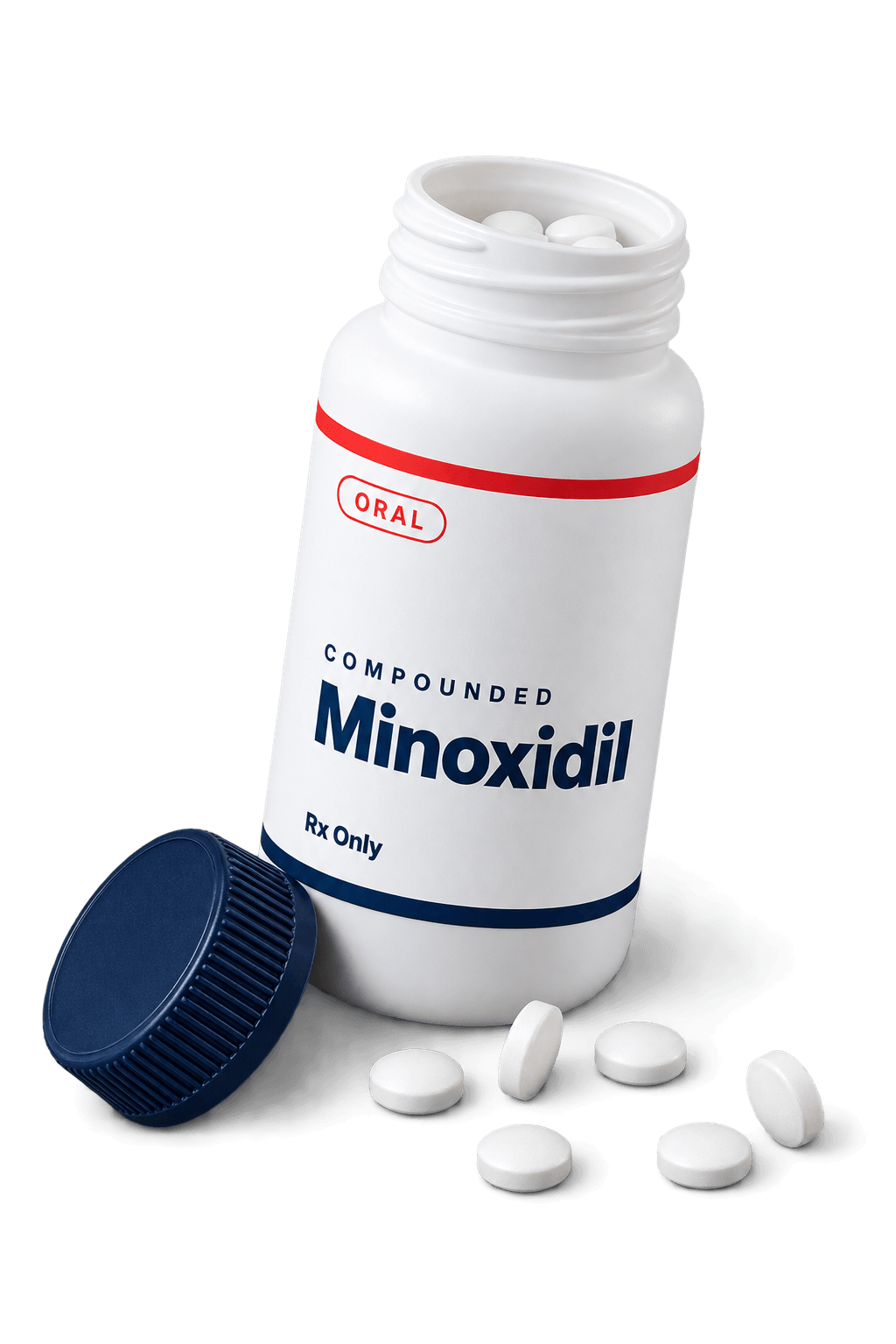
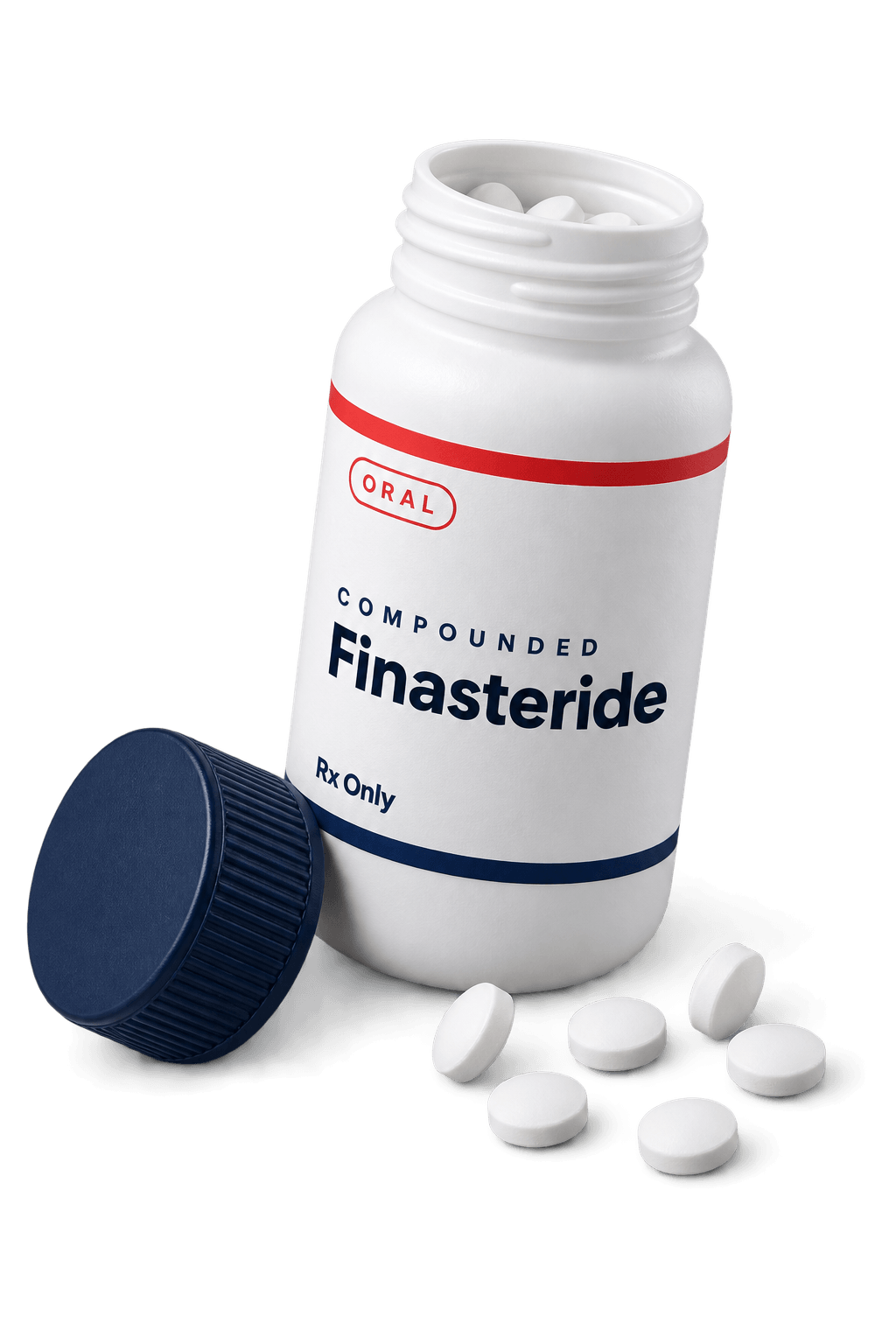
Finasteride lowers DHT by blocking the enzyme that makes it. Minoxidil prolongs the growth phase and improves blood flow to the follicle. They are often used together.
Patience is part of the prescription.
Hair grows in slow cycles. FDA labeling for finasteride says daily use for three months or more is generally needed before a benefit is seen, and gains reverse within about a year of stopping.
The facts, at a glance.
of men show some degree of male pattern hair loss by age 50, according to the American Academy of Dermatology
is how long a follicle's growth phase lasts; DHT shortens it with each cycle
of daily use before a change is expected, per finasteride's FDA labeling
The hair cycle, phase by phase.
Every follicle runs the same loop for life. DHT shortens the first phase; treatment is about protecting it. Tap a phase.
Two to six years of steady growth. Around 85 to 90% of the hairs on a healthy scalp are here at any moment. DHT shortens this phase a little more each cycle in sensitive follicles; minoxidil works to prolong it.
Phase lengths are population ranges from the dermatology literature. Nothing you tap here is stored or sent.
From testosterone to a thinning crown.
Four steps take a normal hormone and turn it into a receding hairline, and each medication interrupts a different one.
- 1Testosterone becomes DHT
An enzyme called 5-alpha reductase converts some testosterone into dihydrotestosterone, or DHT, a stronger form. Finasteride blocks this enzyme.
- 2DHT binds in the follicle
Follicles at the temples and crown carry receptors that are genetically more sensitive to DHT. Follicles on the back and sides usually are not, which is why they hold on.
- 3The growth phase shortens
Each cycle, the follicle spends less time growing and produces a finer, shorter hair. Over years this is what reads as thinning. Minoxidil works here, prolonging the growth phase.
- 4Miniaturization
Eventually the follicle produces only fine, colorless hair, then none. Treatment aims to catch follicles before this stage; it cannot reopen ones that closed long ago.
Who it is for, and who it is not.
Usually a fit
- Men with thinning at the temples or crown, the pattern DHT produces
- Willing to take a daily tablet for the long term, since gains reverse after stopping
- Evaluated by a licensed provider, who confirms the pattern and screens for other causes
Not a fit, or needs a closer look
- Women who are or may become pregnant must not take finasteride or handle crushed or broken tablets, per FDA labeling
- Oral minoxidil began life as a blood-pressure medication: low blood pressure, heart conditions or fluid retention need a provider's review first
- Sudden, patchy or diffuse shedding can signal another cause (thyroid, iron, stress, medication) and deserves a clinician's look
- Anyone under 18
A licensed provider makes every prescribing decision from your health history and, where required, your labs. Not everyone is approved, and if you are not, you are refunded in full.
What the first months look like.
- Day 0Intake and review
A short online visit with photos of the areas that concern you. A US-licensed provider reviews it, usually within an hour or two.
- DaysFirst shipment
The pharmacy prepares your order in 1 to 2 business days on average, then it ships next-day air in plain packaging.
- Weeks 1 to 8Nothing visible yet
The medications are working at the follicle, but hair grows slowly. Some people notice extra shedding early with minoxidil as follicles reset; it usually settles.
- Months 3 to 6First changes
Less shedding tends to come before visible regrowth. Photos in the same light and mirror, once a month, show more than the daily glance.
- Month 12 and onJudge and continue
A year is the fair point to judge results with your provider. Both medications are ongoing: stopping lets DHT and the old cycle take over again within about a year.
What we offer for this.
Every treatment starts with a $0 online visit and ships free, in plain packaging, from a licensed US pharmacy. Prescription only, at the provider's discretion.
Ask the concierge.
An automated guide to these treatments, one tap at a time. Not a real person and not a doctor; a licensed US provider makes every treatment decision.
Loading the guide. If it does not appear, the treatments are listed above.
The questions people actually ask.
Are these the FDA-approved medications?+
What about sexual side effects from finasteride?+
Does finasteride change my PSA?+
Why a minoxidil tablet instead of the foam?+
Will my hair come back fully?+
Where this comes from.
- American Academy of Dermatology, male pattern hair loss (opens in a new tab)
- DailyMed, finasteride 1 mg tablet labeling (opens in a new tab)
- DailyMed, minoxidil topical labeling (opens in a new tab)
- NIH StatPearls, Androgenetic Alopecia (opens in a new tab)
Written from FDA labeling, clinical guidelines and the studies cited below. Educational, not medical advice, and not a substitute for talking with a licensed provider. Compounded medications offered by Freedom RX are prepared by state-licensed 503A pharmacies for an individual prescription; they are not FDA-approved and have not been evaluated by the FDA for safety, effectiveness or quality. For a medical emergency, call 911.

Ready to get personalized treatment?
Start your online visit. It takes about five minutes, and if a provider does not approve your treatment you are refunded in full.